 House Clearance Wandsworth: Health and Safety Policy for Clearance and Rubbish Services
Purpose: This policy sets out the health and safety standards for our house clearance operations within the broader rubbish company service area. It applies to all staff, contractors and subcontractors involved in house clearance, waste removal and rubbish removal activities. The aim is to minimise risk to people, property and the environment while delivering efficient waste removal service area support. All operations will be carried out in line with best practice and sound risk management principles.
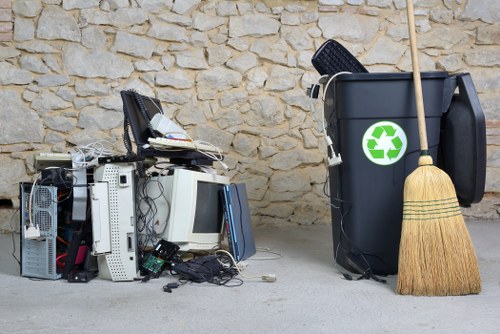 Scope: The policy covers domestic and commercial clearances, disposal of general household waste, segregation of recyclable materials, and safe handling of bulky or hazardous items. It addresses site assessment, lifting and carrying, vehicle loading, traffic management, use of personal protective equipment (PPE) and communication protocols. Key service variations include rubbish removal Wandsworth, local rubbish clearance and general clearance service area operations tailored to client needs. The following core safety controls will be maintained:
- Pre-clearance site assessment and hazard identification
- Safe handling and manual handling controls
- Use of appropriate PPE and safe vehicle loading procedures
Responsibilities and Roles
Management is responsible for implementing this health and safety policy across the rubbish company service area. Managers will ensure that risk assessments are current, staff are trained, equipment is maintained and that incidents are investigated. Risk ownership includes periodic reviews and updates to procedures that reflect changes in operations or regulations.
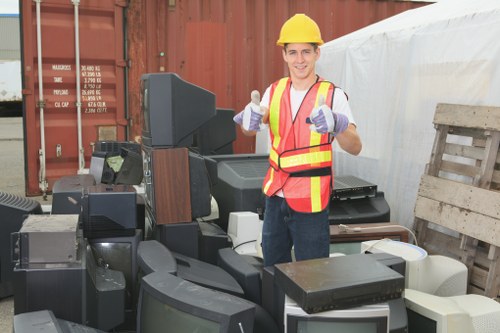 Operatives and crews must follow safe systems of work, report hazards, and use PPE correctly. This includes safe manual handling techniques, correct use of lifting aids and trolleys, and adherence to vehicle loading limits. Staff are required to pause work and seek clarifications when an uncontrolled risk is identified. Communication of hazards to team members and clients during the clearance process is essential for maintaining safety standards.
Contractors and subcontractors operating within the waste removal service area must supply their own risk assessments and method statements where appropriate, and cooperate fully with the appointed manager on-site. All personnel must be familiar with emergency arrangements, including fire procedures and first aid protocols.
Risk Assessment, Controls and Training
 Risk assessment: Before any clearance, a practical, site-specific risk assessment will be completed to identify hazards such as sharps, asbestos-suspect materials, contaminated waste, unstable furniture, biohazards and trip hazards. Where hazardous items are suspected, work will be paused until safe removal arrangements are made. For tasks involving heavy lifting, teams will use mechanical aids and safe lifting plans to protect musculoskeletal health.
Training and competence: All staff engaged in house clearances and rubbish clearance work will receive induction training, manual handling instruction, PPE use guidance and periodic refresher courses. Supervisors will receive additional training in risk assessment, incident investigation and safe vehicle operation to ensure consistent standards across the service area.
 Equipment, PPE and incident management: Vehicles, community skips and handling equipment must be inspected daily and maintained in good working order. PPE—such as gloves, protective footwear, hi-vis clothing, eye protection and masks where dust or biohazards are present—must be worn as required. Incidents and near misses will be recorded and investigated to identify preventative actions and to improve safety systems for the whole clearance operation.
Waste segregation and environmental protection: Proper separation of recyclable materials, general waste and controlled waste reduces risk and supports environmental obligations. Staff will follow internal waste handling procedures to ensure materials destined for reuse or recycling are protected from contamination. Spill control materials and containment steps will be available during vehicle loading and on-site handling to prevent pollution.
Traffic and site safety: Where clearances occur near highways or in communal parking areas, a traffic management plan will be implemented to protect operatives and the public. This includes safe vehicle positioning, use of cones and signage, and coordination with site managers or building occupants. Night work or restricted visibility tasks will be avoided unless adequate lighting and supervisory controls are in place.
Monitoring, review and continuous improvement: This policy will be reviewed at least annually or following any significant incident or operational change. Performance indicators include incident frequency, completion of training, compliance checks and audit findings across the clearance and rubbish removal service area. Lessons learned will be communicated to all teams and used to refine procedures and training.
Commitment: The organisation is committed to achieving and maintaining high standards of health and safety for all stakeholders involved in house clearances and related rubbish services. Leadership, worker involvement and ongoing training are central to delivering safe, reliable clearance and removal solutions across our service area.
Review process: Line managers will document reviews, action plans and completion dates. Where new risks are identified—such as novel waste streams or changed access arrangements—controls will be implemented and communicated before work resumes.
Closing statement: All personnel are required to cooperate with this policy and to exercise care for their own safety and that of others. By following these procedures, the organisation will provide a safe, professional house clearance and rubbish removal service while protecting both people and the environment.